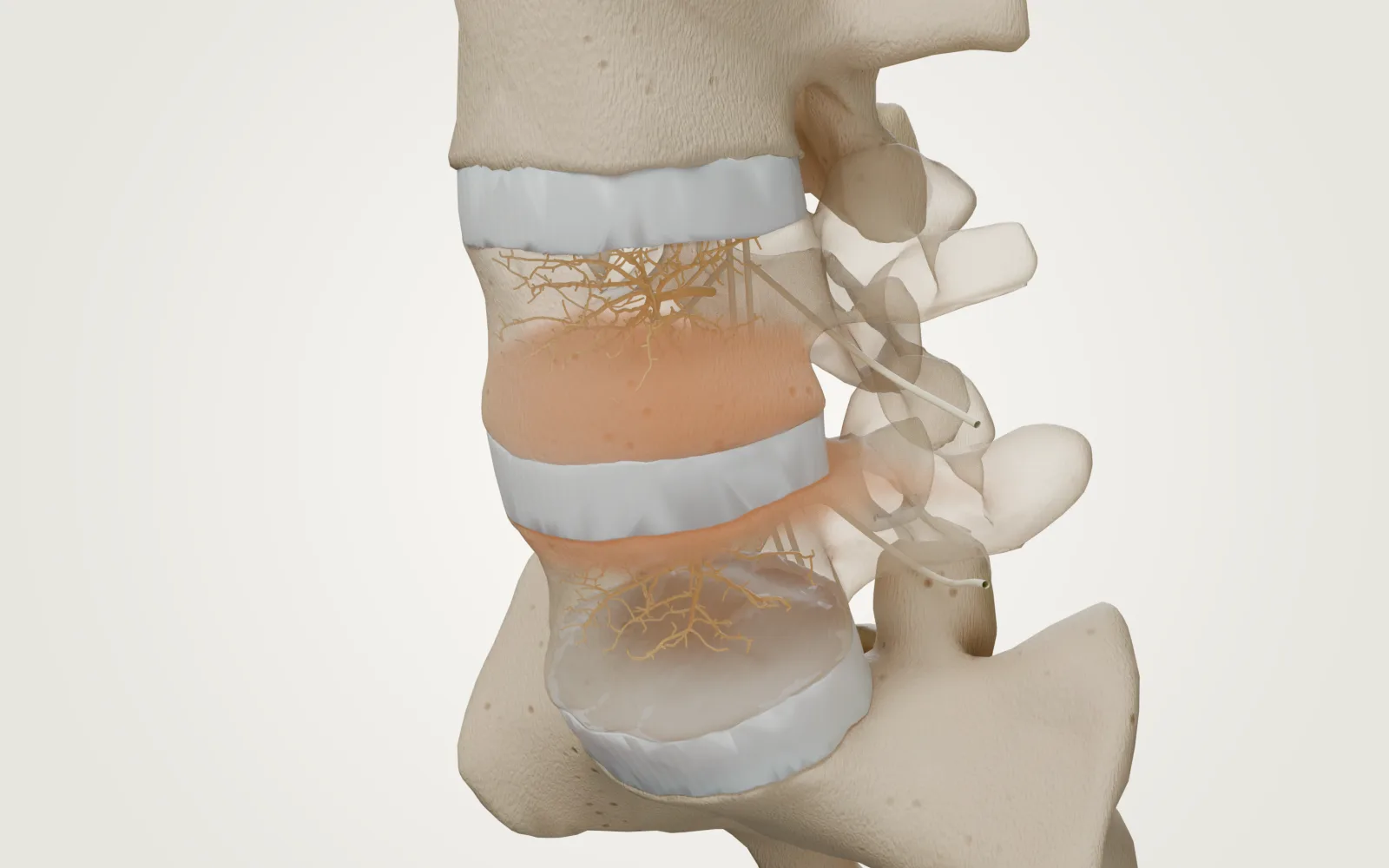
A Modic change on an MRI report describes a pattern in the bone marrow beside a disc’s endplate. “Type 1” means dark on T1 and bright on T2 images, an oedema-like pattern. The words describe what the scan shows. On their own, they do not establish the cause of your pain or a need for surgery. Modic · 1988 Herlin · 2018
Decode the language
| Report phrase | What it is describing | What it does not establish |
|---|---|---|
| “Modic Type 1 endplate changes” | A low-T1, high-T2 marrow pattern beside an endplate | That this is definitely your pain source |
| “Reactive marrow change” | A descriptive signal response in bone marrow | A specific cause by itself |
| “Degenerative endplate change” | Change at the interface between disc and vertebra | A need for surgery |
| “Endplate oedema” | An oedema-like marrow signal near the endplate | Infection by itself |
| “Fatty endplate change” | A fatty marrow pattern, often Type 2 | A severity score |
| “At L4–L5” | The disc level between the fourth and fifth lumbar vertebrae | An exact map of where you feel pain |
The full report matters. These phrases may be used alongside disc, facet, canal and nerve-root findings. Modic · 1988 Herlin · 2018
Why T1, T2 and STIR differ
MRI sequences emphasise different tissue properties. Type 1 looks dark on T1 and bright on T2. Fat-suppressed T2 or STIR helps make oedema-like signal visible while reducing fat signal. A clinician or radiologist interprets the combination, not a single bright patch. Herlin · 2018
Symptoms that need a different conversation
Fever or feeling systemically unwell with back pain, or a history suggesting infection or inflammatory back disease, needs clinical assessment. Modic is not a label that rules out other conditions. NICE · 2016
Six questions to take with you.
You do not need to understand every technical term before your appointment.
- Where are the changes, and which MRI sequences show them?
- What makes you think they do, or do not, explain my pain?
- What other possible pain sources have you considered?
- What is a realistic plan for conservative care, and how will we review progress?
- For any proposed treatment, how closely do I match the people in its trials?
- What are the benefits, harms, alternatives, costs and reasons it might not help?