Intracept is a device system used for basivertebral nerve ablation (BVNA). It targets a nerve within the vertebral body, aiming to reduce pain signalling from the endplate region. It does not remove the disc or repair the MRI change. Boston Scientific · 2025
Where the probe goes
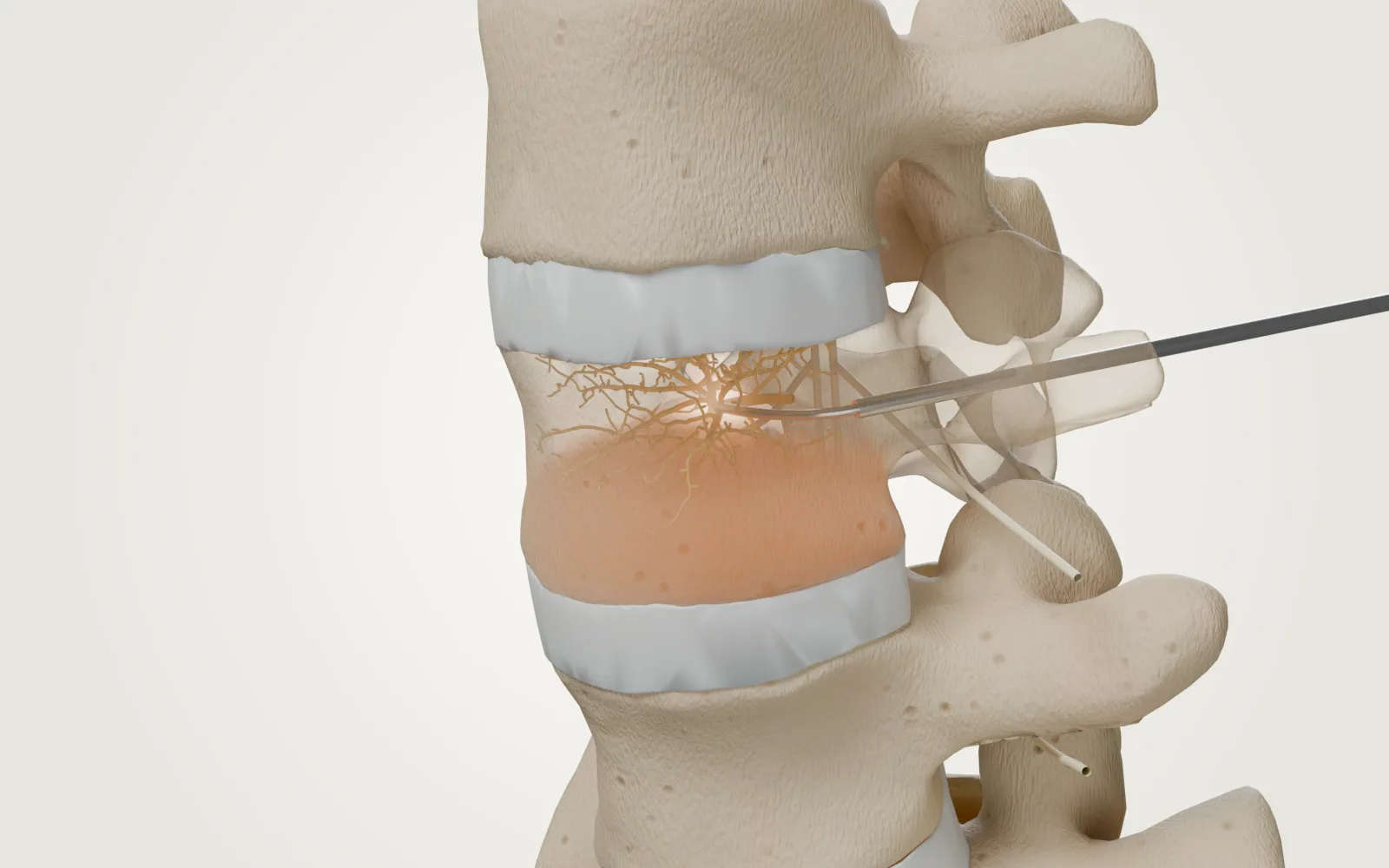
This is an original, simplified illustration of one level. It is not operative training or a map of your anatomy.
What “vertebrogenic pain” means
Clinicians use this term for pain thought to come from the vertebral endplate region. The framing is prominent in device-industry-linked research. It is a proposed clinical pain mechanism, not a settled diagnosis that an MRI label can establish on its own. Other sources of pain can coexist. Fischgrund · 2018 Smuck · 2021
Who was studied and who the label covers
The labelled population is selected
Boston Scientific · 2025The EU label covers L3–S1, chronic low back pain for at least six months, failed conservative care for at least six months, and Modic Type 1 or 2 features.
- Who was studied
- Labelled patient population
- Compared with
- Not a trial comparison
- Outcome & follow-up
- Device indication · At treatment selection
- Limits
- Label criteria are not a diagnosis or an eligibility score; clinical evaluation and contraindications still apply.
- Funding
- Manufacturer document; procedure facts, not independent effectiveness evidence.
Trials also applied exclusions. Their results do not predict benefit for every person with Type 1 or 2. A clinical assessment needs to consider other pain sources, neurological symptoms, infection, bone health and the full device contraindications.
The sham-controlled result
SMART: both groups improved
Fischgrund · 2018ODI improved by 20.5 points with BVNA and 15.2 points with sham: a 5.3-point difference on a 0–100 disability scale.
- Who was studied
- 225 randomized adults with chronic low back pain and Modic 1 or 2
- Compared with
- Ablation versus sham procedure
- Outcome & follow-up
- ODI disability, lower is better · 3 months
- Limits
- Per-protocol result; substantial sham response. This is not a comparison with doing nothing.
- Funding
- Relievant Medsystems; industry-supported.
A responder rate is not the added benefit
Fischgrund · 2018A ≥10-point ODI improvement occurred in 75.6% after BVNA and 55.3% after sham.
- Who was studied
- Per-protocol participants in the sham-controlled SMART trial
- Compared with
- Ablation versus sham procedure
- Outcome & follow-up
- ODI responders, ≥10-point improvement · 3 months
- Limits
- Responder rates are within each group; 75.6% is not the added benefit of ablation.
- Funding
- Relievant Medsystems; industry-supported.
Compared with standard care
INTRACEPT: a larger difference, without blinding
Smuck · 2021BVNA improved ODI by 20.3 points more than standard care at three months.
- Who was studied
- 140 randomized patients; BVNA 66, standard care 74
- Compared with
- Ablation versus standard care
- Outcome & follow-up
- ODI disability, 0–100 scale · 3 months
- Limits
- Open-label, no sham control; expectations and care differences may contribute. Industry funded.
- Funding
- Relievant Medsystems; industry-supported.
What five-year follow-up can tell us
Sustained improvement among followed participants
Khalil · 2024At about five years, 249 followed participants had a mean 28.0-point ODI improvement and 4.32-point pain reduction from baseline.
- Who was studied
- 249 of 320 eligible treated participants in three prospective studies
- Compared with
- Own baseline, with no continuing control group
- Outcome & follow-up
- ODI 0–100; numeric pain score 0–10 · Mean 5.6 years
- Limits
- Uncontrolled, selected follow-up; not evidence of the incremental benefit over sham at five years.
- Funding
- Relievant Medsystems; industry-supported.
Without a continuing control group, the long-term change cannot isolate the treatment effect from selection, other care and natural variation.
Risks and reasons to pause
The manufacturer’s IFU lists risks including infection, bleeding, tissue or nerve injury, fracture, increased pain and device problems. Severe cardiac or pulmonary compromise, active implanted pulse generators, pregnancy, active infection and skeletal immaturity are among the contraindications. The planned zone must have the specified clearance from sensitive structures, including the spinal canal. Bone quality needs individual consideration. Boston Scientific · 2025
Absence of a serious complication in a trial does not mean zero risk. Ask about the operator’s experience, alternatives and how complications would be managed.
Afterwards: what changes, and what does not
The manufacturer describes an outpatient procedure with same-day discharge. That is an expectation from patient material, not a guarantee for an individual. The trials measured change over months; immediate response is not the only outcome. The disc and the marrow change stay as they were, because BVNA is aimed at pain signalling. Boston Scientific · 2026 Smuck · 2021
Ask your clinician for a written plan covering wound care, activity, pain medicines, warning signs, review dates and what to do if it does not help. We do not replace that plan with a generic recovery schedule.
Six questions to take with you.
You do not need to understand every technical term before your appointment.
- Where are the changes, and which MRI sequences show them?
- What makes you think they do, or do not, explain my pain?
- What other possible pain sources have you considered?
- What is a realistic plan for conservative care, and how will we review progress?
- For any proposed treatment, how closely do I match the people in its trials?
- What are the benefits, harms, alternatives, costs and reasons it might not help?